


1. Tell us about yourself.
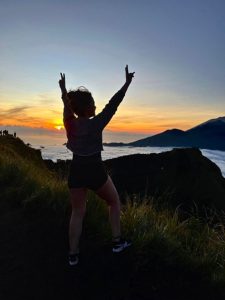
I am Tricia McMillan – the alias I use on Feeld and some swinger sites. Brings me a lot of joy.
I’m a cisgender bisexual woman, writer and journalist.
2. When and how did you realise that polyamory/ENM was a thing and you could transition into this lifestyle?
I can’t remember when I became aware of what non-monogamy in a theoretical sense – which at the time basically meant “couple in an open relationship.” The first non-monogamous person I ever met was my friend S, who has been ENM since before we met in 2008. We are still close friends today, and she was the first person to suggest, when my last monogamous relationship ended in 2018, that it may be for me. At the time I shrugged it off.
It wasn’t until 2022 that I gave it some real thought, when in conversation with a (different, and monogamous) friend who knows me very well said outright that she didn’t think the traditional, monogamous partner that I thought I wanted was what would make me happy. She proceeded to explain why, and it was such a lightbulb moment for me. It still took me a full six months to start living an ENM life, but it was in that moment when I realized that the monogamous, long-term relationship that I thought had eluded me my entire life might, in fact, not be what I actually wanted all along.
3. What kind of polyamory/ethical non-monogamy are you currently practicing?
I am a solo poly, single, and I strongly identify with relationship anarchy. I currently have several long-distance casual partners, whom I see a few times a year.
4. Tell us about a time in the past when you treated someone / did something in a way that makes you feel bad now looking back. What happened, how did the involved parties react, how did the situation get sorted out?
I went on a date with someone who had recently opened up his relationship, and the night did not go great – he was so adamant about expectations management and rules and guidelines and agreements, before anything at all had happened between us, that it took the magic out of the situation. I knew this came from inexperience, both in ENM and in dating as such (dude hadn’t been in a first date in almost two decades), and of fear of how our connection could affect his marriage, but my reaction was very ungenerous. I do believe I had every right to be upset at his assumptions and contradictory statements, but my response was to clam up first and snap at him second, which did nothing to help the situation.
We have since talked about it, and gone on another date, and whereas I have no idea where this will end, I think we have both handled the aftermath well.
5. Tell us how you switched to ENM.
I was single and unattached at the time I decided to try ENM.
6. Tell us about one of your most significant positive ENM experiences.
It is hard to pick a specific experience, as my ENM journey has mostly been a collection of little moments. The first time I successfully de-escalated with someone comes to mind, I loved not having to renounce to the person even though our romantic and sexual relationship ended.
Meeting my metamours is always a high point, and having an on-going relationship with them in whichever way works for us is a highlight of my ENM experience – the time my OG partner’s wife got my number off his phone behind my back so we could get him a birthday present together will always have a special place in my heart.
7. How has polyamory changed you? How are you different today compared to when you switched to ENM? What did ENM give you, what did it take away from you?
I am happier and more content in my relationships than I have ever been before. I’ve struggled with romantic relationships my entire life, and it was a real eye-opener when I realized what I was struggling with was monogamy, not romantic love. I have never had problems being romantically or sexually exclusive, have never cheated on partners – but I did have a lot of internal conflict with compromising and losing my autonomy in the way that monogamous traditional love requires. ENM, and RA in particular, have helped me make sense of that.
Overall, ENM has helped me know myself better. Looking back, I understand why my first ENM friend suggested it might be for me – there were signs all along. I never got why romantic partners took precedent and priority over platonic friends, irrespectively of the longevity of each relationship – it was always a headscratcher to me that longtime friends would disappear when they got a new partner, or would start bringing their partner to every single hangout. I also always hated the idea of “just friends” vs. “more than friends” – as if friendship was a consolation price and lesser type of connection. RA has helped me outline my own way of thinking.
I have also felt more understood and connected within the romantic and sexual relationships I have now. ENM has also brought me the chance to have sexual experiences I had always craved but thought were out of reach, has encouraged my curiosity and sense of adventure and has brought invaluable people to my life – whether temporarily or long term.
What’s taken away from me is, in some ways, free time – I spend more time on my phone than ever before. I am a very good long-distance friend and partner, and have always been – I don’t forget to text back and can spend hours on the phone, it is worth the effort but it does get draining.
On a more philosophical note, alongside getting to know myself and my wants and needs better, I have also had to let go of the notion of romantic love that had been spoon-fed to me (and everyone else) my entire life. I have always struggled to leave behind my autonomy and identity with monogamous relationships, and it is a relief to know that I won’t have to sacrifice that in order to have love, and vice versa – I do not want children, or to ever share a living space with a partner again, and ENM accepts that in a way that monogamy doesn’t. However, my mind had always clutched the idea that the reason I struggled was because I hadn’t met “the one,” and once I did, all of those concerns would become easier to manage “through the power of love” and it would be worth it. I now know that that is not the case, and whereas that is ultimately for the better, it has been a grieving process letting go of the concept of happily ever after.
8. Share with us any of your boundaries that help you navigate in ENM.
No monogamous partners, even if just for something casual. Save yourself the trouble.
One of the first pieces of advice I received was to never be the first for anyone. The advice was specifically about not joining a couple for their first threesome, but in my experience it applies to a lot beyond that – don’t be the first date of someone who just opened up their relationship; don’t be the first sexual experience of someone who recently opened up their relationship, even if they have had other dates before; don’t be the first female partner for a bi-curious woman; don’t be the first overnight guest at your married partner’s family home, even if they are very experienced in ENM. There is something special about being the first experience for someone and we all have been newbies at one point, but the chances for an unsavory situation are very high. I recognize this is a tough piece of advice to follow, I don’t always succeed but I try to abide by it as much as possible.
This next one is just a temporary boundary, or a break, but at the moment I am not interacting one-on-one with partnered people, as I’ve reached saturation point in regards to partners with primaries. I am sure I will discard this rule in the future, but for now any connections with partnered individuals, even if they are casual, are off the table.
I also have some specific boundaries regarding couples I join as single woman. I need to speak or text with both of them (separately or in a group chat) before meeting. No bi-curious or heteroflexible women, unless they are just planning to have the woman watch for which I need advanced notice. I will also not meet alone with any of them, unless it is an ongoing thing and trust has been established.
Sadly, this is a community ripe with flakiness – I give two chances. You cancel twice, you’re out.
No cheaters, ever. Just why.
9. Do you have difficulties fitting into society in any way due to your ENM lifestyle? How is this choice of yours accepted by your wider family/friends circle?
As a single woman, I’ve found that it is relatively easy to “come out” as ENM to my loved ones. Most of my friends know, and some of my family members know, too – it has been easy opening up to them, since I am so sure of my decision that I don’t hugely fear any potential judgement (besides the sting of feeling unaccepted, obviously).
The response from my circle has been overwhelmingly positive, with the exception of a very close friend who has expressed “concern” that “I may be going through something.” She and I have talked about it since, and are still talking about it – and we have made good strides on this.
This general acceptance, however, comes with a very big caveat. Society is way more accepting of a single person dating and having multiple partners than it is of a couple opening up – especially if they’re married, people have so many thoughts and opinions on marriage – but I’ve come to learn that it is because, in many cases, people just assume it is a temporary thing, until you find “the one.” I have seen that when I’ve gone through hard times or struggled with partners, and the response I get from friends is typically along the lines of “sounds like you want a monogamous relationship.” Ouch.
This realization came painfully, and makes me wonder whether my loved ones actually believe and accept this decision – and in a twisted way, makes that friend who reacted with worry the only one to truly accept it, as she clearly believed me.
10. Is there anything in ENM lifestyle that you find difficult? Tell us about it.
The admin! All the logistics involved in managing several people’s schedules, plans and lives. At the moment all my partners are long distance, so this is somewhat manageable – since I’m typically in town for just a few days, including me in their schedules is straightforward. But I’ve wondered many times (and discussed with my partners) what it would be like if we lived in the same city (which might happen in the near to medium future).
I can’t say exactly what the reason is, but I have struggled to meet other solos. Might be pure coincidence, but since I started ENM I have mostly met couples and partnered people. Whereas this is not an issue in itself, it does come with its own set of difficulties and adjustments on my part, of which I’ve reached my limit at the moment.
On that note, I also feel like the community is heavily skewed towards couples. The vast majority of the literature out there is about couples opening up and the issues they face, there is very little about single people or solos and how to navigate the lifestyle as a party of one. Couples also seem to believe that being solo is the easier position – which is absolutely not true, each side comes with its own set of advantages and struggles.
This is not strictly ENM (and I feel like a dick mentioning it, but…), but since I adopted the lifestyle I have come in contact with more neurodivergent people than ever before – this might be purely anecdotal, but there seems to be a high proportion of neurodiversity in the ENM community (which seems pretty logical to me when I think about it, really). As a neurotypical individual, I find interacting with people in the autism spectrum or people with ADHD a struggle at times.
I have also found that for some people in the community, ENM is their entire identity – all they do is go on dates and have sex, and talk about dating and having sex. Sometimes I’ve found myself bored around members of the community, for this reason. This is just an observation, similar to people for whom their job is their whole identity, for example – but I also find workaholics very tedious…
11. Describe your efforts and best practices in terms of STD prevention. What are your safety recommendations ENM-wise?
Safer sex1 is non-negotiable for me, and I get tested at least every three months, or whenever I get a chance (I currently live in a country where such tests are not available, so I get tested every time I travel which thankfully is a lot).
Everybody’s level of tolerance is different, and it’s important to be clear about it with potential partners and respect their own risk thresholds. I do believe, however, that ending the stigma around STIs (which very much exists, even within the community) includes recognizing that the vast majority of them pose a minor risk, as they are easy to treat with readily accessible drugs, and even the few infections that are still chronic are not life-threatening anymore. STIs deserve our attention, and protection from them is of utmost importance for everyone, but let’s not treat them with any more gravity than what they rightfully deserve.
12. Share your best practices that you follow at ENM and why they are important to you.
Not very original, but open, transparent and kind communication is key – and all those components are non-negotiable: honesty and compassion are not mutually exclusive, and straightforwardness should never be an excuse for cruelty.
On that same vein, I found that knowing how to ask questions and not making assumptions on what people are thinking or feeling is just as important as being able to clearly express our own feelings and thoughts – neither us nor our partners are mind readers.
13. What did we miss to ask you that is important? Place the question and answer it 🙂
N/A
- The term “safer sex” explained here: https://www.plannedparenthood.org/blog/whats-the-difference-between-safe-sex-and-safer-sex ↩︎
Note from People of poly: The interviews are published unedited in the original language in which they were conducted. The interviews are translated by a non-professional.
Leave a Reply